Grai Orthopedic Implants Grai Orthopedic Implants

Best China Orthopedic Implants How to Check Quality?

Time:2026-10-18 Author:Madeline
0%

Choosing the best China orthopedic implants requires more than checking a polished catalog or a low price. Quality appears in controlled details, from raw material certificates to final packaging. A reliable evaluation should examine how the manufacturer controls every production stage.

The key question is: How to check the production quality control of orthopedic implants? Start with the quality system. Review ISO 13485 certification, internal audit records, supplier approval procedures, and employee training. Then inspect material traceability. Each titanium alloy batch should connect to purchase records, chemical analysis, machining history, and inspection results.

Look closely at the factory floor. Are instruments calibrated? Are critical machining parameters recorded? Do workers separate accepted components from rejected parts? Small details matter. A missing label can become a serious traceability weakness.

W. Edwards Deming, a leading quality-management authority, stated, “Quality comes not from inspection, but from the improvement of the production process.” His principle remains practical for orthopedic manufacturing. Inspection cannot repair poor design controls or unstable processes.

A strong supplier should provide evidence for dimensional testing, surface-finish checks, fatigue testing, cleanliness verification, and sterilization validation. Review sample reports rather than accepting general promises. Ask how nonconforming implants are isolated, investigated, and prevented from recurring.

The assessment should also include packaging integrity and storage conditions. An implant may meet specifications, yet poor packaging can damage its surface before surgery. This point is easy to overlook.

No factory is perfect. That is why transparent records, corrective actions, and honest communication deserve attention. A manufacturer that admits weaknesses may be more trustworthy than one claiming flawless production. Quality is not a slogan. It is a repeatable process supported by evidence.
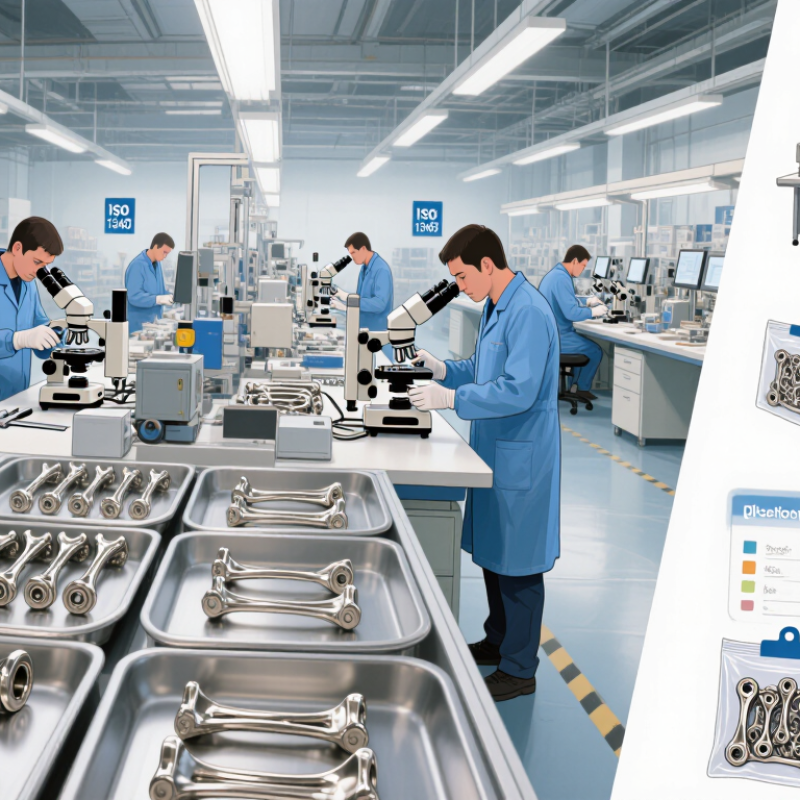
Best China Orthopedic Implants How to Check Quality?

What Defines a High-Quality Orthopedic Implant in China?

A high-quality orthopedic implant in China begins with verified materials, not attractive packaging. The supplier should provide material certificates, production records, and batch-level traceability. Titanium or stainless steel must match the declared medical grade. Surface finish also matters. Rough edges, uneven coatings, or visible pores may increase clinical risk.

Manufacturing control defines consistency. Inspectors should review machining accuracy, sterilization records, packaging integrity, and documented quality tests. Independent laboratory reports can support claims about strength, fatigue resistance, corrosion behavior, and biocompatibility. The manufacturer should also demonstrate experience with similar implant designs and maintain a clear process for handling complaints or product deviations. Ask for evidence.

Clinical suitability deserves equal attention. A strong implant is not automatically suitable for every patient, anatomy, or surgical technique. Technical drawings, surgical instructions, and risk assessments should be clear and current. Regulatory documentation from relevant authorities adds confidence, but paperwork alone does not prove real-world performance. Speak with qualified orthopedic professionals when evaluating design changes.

No inspection method is perfect. A factory visit may show excellent cleanliness while missing weaknesses in supplier control. A certificate may be genuine but incomplete. Review records carefully, compare samples from different batches, and question unusual results. Quality is built through repeatable processes, honest disclosure, and measured performance over time. Small details matter.

Which Standards and Certifications Should Be Verified?

When evaluating orthopedic implants from China, verify certifications against the exact product and manufacturing site. ISO 13485 should cover the company’s quality management system. Check the certificate number, issuing body, validity period, and approved scope. A certificate for instruments may not cover implants.

Confirm registration with China’s National Medical Products Administration when the product is manufactured or sold in China. For overseas use, review the applicable market authorization, such as European Medical Device Regulation requirements or United States clearance. A CE mark alone does not prove clinical performance. Ask for the declaration of conformity and technical documentation.

Material evidence matters too. Request test reports for titanium, stainless steel, or polymer components. Relevant ISO and ASTM standards should match the implant’s material, design, and intended use. Review biocompatibility testing under ISO 10993, risk management under ISO 14971, and sterilization validation under ISO 11135 or ISO 11137, when applicable. Packaging should be assessed under ISO 11607.

Look closely at batch records, surface-finish results, dimensional inspection, and traceability labels. Lot numbers should connect the finished implant to raw materials and inspection data. Ask whether tests were performed by an independent, accredited laboratory. Documents can look complete while missing critical details. I would also compare certificate dates with production dates and inspect sample packaging personally. That extra check often reveals weak labeling, unclear revision control, or gaps between paperwork and actual manufacturing practice.

How to Assess Implant Materials, Design, and Manufacturing

When checking China orthopedic implants, start with materials, not brochures. Titanium alloys should match the intended anatomical load and corrosion environment. Cobalt-chromium alloys offer high wear resistance, but material selection must fit the bearing surface. For polymers, inspect oxidation control, sterilization validation, and packaging integrity. ISO 10993 testing helps assess biological safety, but it does not prove clinical success. Ask for heat numbers, raw-material certificates, and independent chemical analysis.

Design quality appears in small details. Check fatigue testing, locking mechanisms, edge geometry, and instrument compatibility. The UK National Joint Registry’s 21st Annual Report tracks more than four million joint replacement procedures. Its findings show that revision risk varies with fixation, bearing choice, implant design, and patient factors. Therefore, a ten-year survival curve is more useful than a low purchase price. Laboratory strength alone is insufficient. Real patients are less predictable.

Manufacturing evidence should be specific. Review process validation, CNC inspection records, surface-treatment controls, cleaning results, and sterilization records. Confirm that every implant has lot-level traceability. ISO 13485 certification supports a quality system, but certificates can become outdated or incomplete. I would request recent audit findings, not only a certificate copy. Also compare dimensional tolerances with the approved technical drawings. One overlooked tolerance can affect alignment, micromotion, and revision risk. Perfect documentation is rare, and that deserves scrutiny.

Best China Orthopedic Implants: How to Check Quality? — How to Assess Implant Materials, Design, and Manufacturing
Assessment Area Quality Dimension What to Check Evidence or Test Method Practical Acceptance Indicators Priority
Materials Material identity and grade Confirm the exact alloy or polymer grade, chemical composition, mechanical properties, and applicable material standard. Material certificate, heat or lot number, supplier traceability, and independent chemical analysis when required. Material designation on the certificate matches the drawing, purchase specification, and device labeling; the lot can be traced to the finished implant. Critical
Materials Titanium alloy suitability For titanium implants, assess whether the selected grade is appropriate for load, fatigue, corrosion, and biological requirements. Review compliance with recognized specifications such as ISO 5832-3 or ASTM F136 for titanium alloy used in surgical implants. Composition and mechanical results fall within the declared standard; no unexplained substitution between commercially pure titanium and titanium alloy. Critical
Materials Cobalt-chromium or stainless-steel suitability Check corrosion resistance, strength, nickel content where relevant, and compatibility with the intended anatomical application. Review applicable material documentation, corrosion test results, chemical analysis, and mechanical test reports. Material is supported by a recognized implant-material specification and is compatible with the intended sterilization and clinical environment. High
Materials Polymer and radiolucent components For PEEK or other polymers, verify polymer grade, additives, fiber reinforcement, moisture control, and thermal-processing history. Raw-material certificate, formulation control, processing records, dimensional inspection, and relevant biocompatibility assessment. The polymer grade and reinforcement content are consistent across production lots; no unauthorized recycled or reprocessed material is used. High
Materials Biocompatibility and biological safety Evaluate patient-contacting materials, residues, cleaning agents, coatings, colorants, and manufacturing contaminants. Biological evaluation plan and reports aligned with ISO 10993, based on contact type, duration, and the complete finished device. Assessment covers the finished, sterilized product and includes a documented risk-based justification for each required endpoint. Critical
Design Clinical intended use Check anatomical indication, patient population, load environment, fixation method, surgical approach, and contraindications. Intended-use statement, risk-management file, clinical evaluation, surgical technique, and device labeling. Design inputs are clinically specific and are linked to verification, validation, and risk-control measures. Critical
Design Dimensional accuracy and fit Review critical dimensions, tolerances, hole locations, thread geometry, mating interfaces, and compatibility with instruments. Approved drawings, 3D inspection reports, calibrated gauges, coordinate-measuring-machine records, and first-article inspection. Critical dimensions meet approved tolerances; mating parts assemble smoothly without excessive play, binding, or mismatch. Critical
Design Fatigue and static strength Assess the highest-risk load cases, stress concentrations, locking features, screw interfaces, and expected service conditions. Bench testing and, where appropriate, finite-element analysis based on recognized methods such as ASTM F382, ASTM F543, or device-specific standards. Test configuration represents the clinical worst case; acceptance criteria are defined before testing and failures are investigated. Critical
Design Wear, fretting, and particulate risk Examine articulating, modular, threaded, and contact interfaces for wear, fretting, debris generation, and loss of fixation. Wear or fretting test results, microscopic inspection, dimensional changes, debris characterization, and risk assessment. No unacceptable deformation, cracking, galling, or particulate generation under representative simulated-use conditions. High
Design Surface finish and coating integrity Check roughness, porosity, coating thickness, adhesion, coverage, sharp edges, burrs, and exposed substrate. Surface-roughness measurement, coating inspection, adhesion testing, microscopy, and validated acceptance criteria. Surface characteristics support the intended fixation or articulation function; no loose coating, sharp edge, burr, or visible contamination is present. High
Manufacturing Quality management system Verify that the manufacturer operates a controlled medical-device quality system covering design, production, purchasing, complaints, and corrective actions. Current ISO 13485 certificate, scope review, audit findings, management-review records, and corrective-action history. Certificate scope covers the relevant implant category and manufacturing activities; major unresolved audit findings are not present. Critical
Manufacturing Process validation Identify processes whose output cannot be fully verified by later inspection, including cleaning, coating, heat treatment, additive manufacturing, and sterilization. Validated-process protocols, operational qualification, performance qualification, revalidation triggers, and process-monitoring records. Validation uses defined worst-case conditions and demonstrates repeatable results within documented operating limits. Critical
Manufacturing Machining and additive manufacturing control Review machine capability, build orientation where applicable, powder or feedstock control, heat treatment, support removal, and post-processing. Machine-maintenance records, calibration certificates, build records, parameter control, metallographic examination, and lot acceptance tests. Critical process parameters are controlled and recorded; nonconforming builds or parts are segregated and dispositioned under procedure. High
Manufacturing Cleaning and contamination control Assess residues from oils, detergents, polishing compounds, metal particles, endotoxins, and other process contaminants. Validated cleaning procedure, residue testing, particulate inspection, bioburden or endotoxin testing where applicable, and environmental controls. Cleaning limits are scientifically justified, routinely monitored, and linked to the final packaging and sterilization state. Critical
Manufacturing Sterilization and sterile barrier Confirm sterilization method, dose or cycle parameters, packaging configuration, seal integrity, and claimed shelf life. Validated sterilization report, routine-release records, packaging validation, accelerated-aging data, and distribution simulation. Sterility claims are supported for the marketed configuration; package seals remain intact after aging and transport simulation. Critical
Manufacturing Traceability and recall readiness Check whether each implant can be traced from raw material and production records to inspection, sterilization, packaging, shipment, and customer. Unique device identifier or equivalent identification, batch records, device history records, distribution records, and mock-recall results. Affected lots can be identified quickly and accurately without relying solely on manual or incomplete records. Critical
Verification Final inspection and release Review sampling plans, acceptance criteria, visual inspection, dimensional inspection, packaging checks, and release authorization. Device history record, inspection checklist, calibrated equipment records, nonconformance reports, and authorized quality-release signatures. Every released lot has complete records, objective evidence of conformity, and documented resolution of deviations. Critical
Compliance Regulatory and technical documentation Compare product claims, intended use, risk controls, test reports, labeling, and registration or market-access documentation. Technical file, risk-management report aligned with ISO 14971, clinical evaluation, conformity assessment, and post-market surveillance records. Claims are consistent across documents; test reports identify the tested model, lot, method, acceptance criteria, and final conclusion. Critical
Supplier Audit Independent verification Do not rely only on certificates supplied by the manufacturer; independently verify high-risk material, dimensional, mechanical, and sterility information. Qualified third-party laboratory testing, on-site audit, witnessed production inspection, and random sampling from sealed production lots. Independent results agree with the manufacturer’s records, and any discrepancy is formally investigated before acceptance. High
Important: Acceptance criteria must be defined for the specific implant type, intended use, applicable jurisdiction, and recognized device standards. Certificates and test reports should be verified against the actual finished product, production lot, and sterilized packaging configuration.

How to Review Testing, Sterilization, and Traceability Records

Best China Orthopedic Implants: How to Check Quality?

When reviewing China orthopedic implants, I start with records, not polished photographs. A quality file should identify the exact implant, material grade, dimensions, and revision history. Testing reports should show sample numbers, methods, acceptance criteria, and qualified laboratory details. Check whether mechanical, fatigue, corrosion, and biocompatibility tests match the implant’s intended use. Dates matter. A report from another design may be irrelevant.

Sterilization records deserve close attention. Look for the validated cycle, load configuration, equipment identification, and biological or chemical indicator results. For radiation sterilization, review dose mapping and routine dose audits. For ethylene oxide, inspect exposure parameters, residual testing, and aeration records. Packaging integrity testing is also important because sterility ends when the barrier fails. Do not accept a single certificate as complete evidence.

Traceability should connect raw material certificates to production batches, inspection results, sterilization loads, and final release. Ask for simulated recall records. Can the manufacturer locate every affected lot quickly? I prefer controlled originals, signatures, timestamps, and clear corrections. Missing pages are a warning. Still, paperwork is not reality. An on-site audit, retained-sample review, and independent verification can expose gaps. My own review would include questions that may feel inconvenient. That is often where quality becomes visible.

How to Evaluate Chinese Suppliers and Product Reliability

Best China Orthopedic Implants: How to Check Quality?

Evaluating Chinese orthopedic suppliers requires more than reviewing a product catalogue. Request current ISO 13485 certification and confirm its scope. Check whether the certificate covers the exact implant category. Ask for material certificates, dimensional drawings, and sterilization validation records. Reliable suppliers should provide lot numbers and traceability from raw material to shipment. Missing records deserve attention.

Request production samples from normal batches, not specially prepared units. An independent laboratory can assess chemical composition, fatigue strength, surface finish, and corrosion resistance. Compare these results with the supplier’s technical specifications and applicable market requirements. Visit the factory if possible. Observe cleanroom controls, calibration labels, packaging areas, and rejected-part storage. A polished factory tour can mislead.

Look closely at post-market support. Ask how complaints are investigated, how recalls are managed, and how quickly technical documents are updated. Speak with hospitals or distributors that have used similar products, while protecting patient confidentiality. One common mistake is choosing the lowest quotation before checking testing depth. Another is trusting certificates without verifying their issuing bodies. Suppliers may answer slowly or provide incomplete files. That is a risk, but it also reveals their working habits. Product reliability depends on consistent processes, honest communication, and evidence collected over time.

FAQS

Which materials should be checked in orthopedic implants?

Confirm the alloy or polymer matches the body area, load, and corrosion environment. Ask for material grades, heat numbers, raw-material certificates, and independent chemical analysis. Material choice matters.

Does biological safety testing prove an implant will succeed clinically?

No. Biological testing supports safety assessment, but it cannot prove long-term clinical success. Review corrosion, fatigue, mechanical, and biocompatibility results together. Patients vary.

What design details deserve close inspection?

Check fatigue performance, locking mechanisms, edge geometry, and instrument compatibility. Compare dimensions with approved technical drawings. A small tolerance error may affect alignment or micromotion.

What manufacturing records should a buyer request?

Request process validation, CNC inspection records, surface-treatment controls, cleaning results, and sterilization records. Each implant should connect to a specific production lot. Missing records worry me.

How can testing reports be judged reliable?

Check the exact implant model, material grade, dimensions, sample numbers, test methods, and acceptance criteria. Confirm the laboratory was qualified. Dates matter.

What should sterilization records contain?

Look for the validated cycle, equipment identity, load configuration, and indicator results. For radiation, review dose mapping and routine dose audits. For gas sterilization, check exposure, residues, and aeration.

Why is packaging integrity important?

Sterility depends on an intact barrier. Review seal strength, package-aging data, transport testing, and visible damage controls. A certificate alone is incomplete.

How should traceability be tested?

Ask the manufacturer to connect raw materials, production batches, inspections, sterilization loads, and final release records. Request a simulated recall. Can every affected lot be located quickly?

Is a quality-management certificate enough?

No. Certificates may be outdated or incomplete. Request recent audit findings, controlled originals, signatures, timestamps, and correction histories. An on-site audit adds useful evidence.

What limitations should reviewers remember?

Laboratory strength does not predict every patient outcome. Paperwork can also hide practical gaps. I might overtrust complete files, so independent verification remains necessary.

Conclusion

Choosing high-quality orthopedic implants from China requires a structured review of product safety, performance, and supplier reliability. Buyers should first confirm that the implants meet recognized medical device standards and hold valid certifications for the intended market. Material composition, biocompatibility, mechanical strength, surface treatment, dimensional accuracy, and design suitability should be evaluated through technical documents and independent testing reports. A key question is: How to check the production quality control of orthopedic implants? This involves reviewing incoming material inspections, validated manufacturing processes, equipment maintenance, in-process checks, and final product release procedures.

Quality assessment should also include sterilization validation, packaging integrity, shelf-life evidence, and complete traceability from raw materials to finished products. Reliable suppliers should provide clear quality records, risk management files, inspection data, and consistent technical support. Their production facilities, quality systems, corrective-action history, and ability to maintain stable batches should be carefully assessed. By combining document review, sample evaluation, factory audits, and performance verification, buyers can make a more informed decision and reduce risks associated with implant reliability and clinical use.

Madeline

Madeline

Madeline is a dedicated marketing professional with a wealth of expertise in our company's core offerings. With a keen understanding of the industry, she brings a unique perspective to her role, consistently delivering high-quality content that highlights the superior aspects of our products. As......